
I. Introduction
Negotiation lies at the heart of legal practice — yet even highly trained negotiators regularly reach suboptimal agreements. This problem is widespread. Seventy percent of major M&A deals fail to close or fall short of parties’ aspirations. Almost forty percent of international peace agreements unravel within five years. Some estimates suggest up to twenty-seven percent of criminal defendants who plead guilty in America may be innocent. Even in personal relationships, where parties often share strong incentives to cooperate, approximately half of U.S. marriages end in divorce. What drives this problem and how can we begin to overcome it? While there is no single answer, three factors are too often overlooked by legal practitioners: identity, emotion, and psychological biases.1 These factors interact within a negotiation system that requires constant prioritization, a systemic dynamic that remains undertheorized. Negotiation shortcomings often stem not from a lack of tools, but from the failure to effectively prioritize rational, emotional, and identity-based interests within a system pervaded by psychological biases.
Despite the increase in negotiation training at law schools over the past half century, negotiation scholarship is often confined to specialized journals, separate from mainstream legal scholarship. This sequestration is understandable given the many important areas of substantive law and procedure to be covered, but also surprising for a profession that uniquely integrates practice and scholarship. Indeed, the entire U.S. judicial system depends on negotiation: Ninety-eight percent of federal criminal cases result in negotiated plea bargains and a similarly high percentage of civil suits are settled prior to trial. This essay, though brief, takes a step toward bridging the law journal–negotiation divide and offers a framework for understanding how traditional negotiation considerations interact with identity, emotion, and psychological biases within negotiation systems.
II. Understanding Identity and Emotion in Negotiation
What is negotiation? Negotiation can be defined as any time we are “trying to influence [someone] to do something” or, more broadly still, any “purposive interaction.”2 This means that all people negotiate daily — from convincing friends and colleagues to like them to seeking raises at work, casting a vote, and choosing where to eat for dinner. Lawyers engage in these informal negotiations but are also more likely to regularly participate in formal negotiations, from client fee agreements to corporate deals to litigation. Recognizing that one is negotiating is the first step toward improving the odds of satisfying one’s interests in each negotiation because it enables one to draw upon negotiation tools and best practices. The foundational tools of negotiation — including choosing an integrative negotiation approach over distributive bargaining, differentiating interests from positions, and developing options and alternatives — were first popularized by Professor Roger Fisher and William Ury’s Getting to Yes in 1981 and subsequently expanded on over the past forty-five years.
Despite using these tools, lawyers and non-lawyers regularly reach suboptimal agreements. So, where do traditional tools of negotiation fall short? As I first wrote in 2020, negotiation scholarship and instruction have often overlooked two interrelated features of negotiation: the importance of emotional and identity-based interests and the challenges of prioritization at different levels of the negotiation system. Six years later, this largely remains the case.3 Although many lawyers receive negotiation training in law school or at their law firms,4 these programs have only recently begun to integrate content on the importance of considering these factors. Where they do, these topics are often touched on briefly, at least relative to their complexity and depth, and may not be situated fully alongside the traditional negotiation.5
Yet what people choose to prioritize, when, and to whom, matters greatly, influencing negotiation processes and outcomes. As one example, any trial lawyer knows the importance of a strong opening statement: How one starts (primacy) and ends (recency) can make all the difference. Whether a lawyer chooses to prioritize evoking emotion and identity (“A single mother, struck on her way to work.”) or logic (“On December 5th, Ms. Smith was hit by a car.”) can anchor how the jury views the client. The same principle applies in opening M&A negotiations, annual reviews, plea bargaining, and divorce proceedings. Emotions and identity are omnipresent in negotiations, shaping how people perceive their interests, options, alternatives, and counterparties.
Whether or not parties realize it, all negotiations involve a combination of rational, identity-based, and emotional interests. (“Interests” is a negotiation term for needs, wants, and desires, as differentiated from “positions,” which are what people say they want. Interests are the “why” underlying positions.) Rational interests include both substantive interests (e.g., basic needs, deal terms, or dollar amounts) and procedural interests (e.g., how and where parties should meet, who participates in discussions, or when an agreement must be reached by). Identity-based interests include beliefs, values, allegiances, and rituals. Emotional interests include appreciation, affiliation, autonomy, status, and role. Collectively known as the “Core Concerns,” Professors Roger Fisher and Daniel Shapiro identified these as emotional interests that all people share. Everyone desires to be appreciated, to feel affiliation with others, to have a degree of autonomy, and to have one’s status and role in society be recognized. Where these interests are disregarded, conflict can ensue. As an example, lawyers negotiating a merger may have a set of substantive and procedural interests they have agreed on with their clients. Each individually also likely desires to be viewed as competent and credible (emotional interest); to leave with a “win” for their client and firm (rational and/or emotional interest); and to ensure that the bargaining is conducted ethically and fairly (identity-based interest). If one lawyer undermines the credibility or competence of another, or engages in quasi-unethical behavior, this may raise tensions and undermine the process of creating collective value.
In addition to shaping the types of interests parties may hold, identity and emotions may also play important roles in shaping negotiation dynamics. As Professor Daniel Shapiro writes, when parties disregard and infringe upon certain aspects of others’ identities, this may trigger a sense of threat and an us-versus-them, “tribal mindset” that can erode collaboration and cause conflicts to spiral. Recognizing these potential pitfalls and leaning into a communal mindset, can mitigate these disruptive impacts. Similarly, people may experience anger, frustration, excitement, nervousness, or any other host of emotions during negotiations, which can affect thinking and communication. This is not to say that such emotions should be suppressed. Instead, they should be internally (or, as appropriate, externally) identified and acknowledged to inform strategy and discourse. If something is making one frustrated, such as a slow process or the other party not understanding something, revealing this can contribute to joint problem solving to address the root cause.
III. Systemic Prioritization in Negotiation
All negotiations can be conceived of as taking place within a broader negotiation system. The negotiation system ranges from the intrapersonal to the interpersonal to the intergroup. Intrapersonal negotiations are those we have internally with ourselves over how we will act or speak to prioritize our interests in the external world.6 Interpersonal negotiations consist of the interactions we have with other individuals. When these take place within a group context, they may also be understood as intragroup negotiations and may in turn inform intergroup negotiations. At the highest level, these intergroup negotiations occur between groups and may include international negotiations, taking place between countries. As Figure 1 illustrates, at each level of the negotiation system, parties must balance their substantive and procedural interests with their emotional and identity-based interests.
Figure 1: The Systemic Prioritization Model
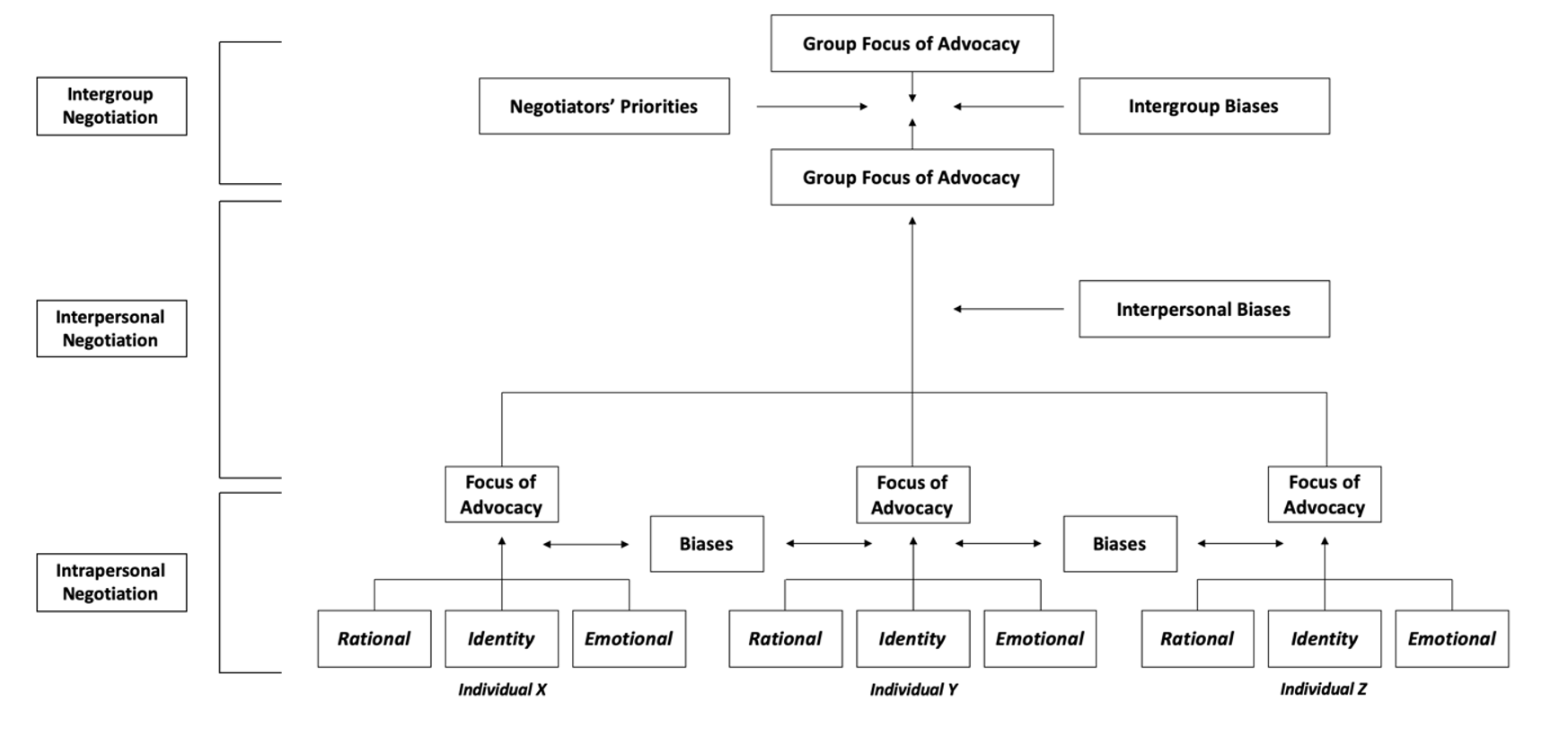
The Systemic Prioritization Model is a relatively simple visual that encapsulates the interplay between different forms of interests and interceding biases at different levels of the negotiation system. At the intrapersonal level, individuals internally weigh rational interests against identity-based interests and emotional interests. As they home in on their “focus of advocacy” — what they prioritize to communicate and advocate for at a given time — individuals contend with psychological biases that may distort prioritization. These biases may include anchoring, stereotypes, loss aversion, confirmation bias, and others. This process of interest weighing and prioritization repeats at the interpersonal and intergroup levels, albeit with potentially different types of interceding biases. These biases may include power asymmetries, groupthink, racism, reactance, sexism, stereotyping, and reactive devaluation. In intergroup settings, the lead negotiator’s own interests may also surreptitiously or inadvertently play a role.
Awareness of the systemic nature of negotiation can help to shape prioritization at each stage: If we recognize who we are trying to ultimately influence, we can adjust what we view as important, and what we should do or communicate at any given time. A client interacting with their lawyer is operating at the interpersonal and intragroup level. The client and lawyer each have distinct interests that they wish to have met. Though the lawyer of course serves the client’s interests, the lawyer also likely wishes to maintain their professional reputation, get compensated, and balance their professional responsibilities with personal commitments. The client wants to achieve their legal goals, whether through litigation or otherwise, while also seeking other interests, such as having their lawyer and others respect them, having the opportunity to tell their story, and reducing time and monetary costs. Simultaneously, these interactions between lawyer and client are in preparation for intergroup negotiations between the lawyer and other lawyers or judicial officers. In their initial intrapersonal and interpersonal negotiations, a lawyer who recognizes these broader client interests and takes the time to build rapport and explore the client’s various interests is more likely to build trust, encourage information sharing, and ultimately develop a strategy for eventual intergroup negotiation better suited to meeting the client’s full array of interests.
How can the Systemic Prioritization Model be used? Beyond serving as a theoretical framework for negotiation scholarship and teaching, the model can serve as a practical tool, reminding practitioners to strategically consider the various layers to their negotiation, as well as the roles of emotion, identity, and interceding biases.7 Regardless of the stakes, from a traffic citation to a death penalty case, to a multibillion-dollar hostile takeover, parties involved will hold both “rational” interests and interests tied to their emotions and identity. True success, and any lasting agreement, will depend on these diverse forms of interests being met. And meeting these interests begins well in advance of arriving in the courtroom or at the negotiation table. The Systemic Prioritization Model can serve as a succinct tool for orienting oneself in the negotiation system and weighing interests while preparing.
IV. Conclusion
Returning to the problem from the start of this piece, improved prioritization alone is certainly not going to magically fix all of negotiation’s shortcomings. But it may help to decrease the percent of suboptimal agreements. Like how being aware that one is negotiating can enable one to draw on negotiation tools to enhance processes and outcomes, recognizing the systemic nature of negotiation and the different forms of interests at play can help those negotiating improve how and what they advocate. The litigator who knows their case is probably destined for the Supreme Court is likely to prioritize different arguments at trial than the lawyer who is unlikely to appeal. Similarly, the M&A lawyer who recognizes the significant value in long-term synergies between companies is likely to negotiate different merger terms than the one who is solely focused on getting the lowest price possible or “pulling one over” on the other side.
By virtue of their profession, lawyers are regularly engaging in negotiations at all levels of the negotiation system, from the intrapersonal and interpersonal to the intergroup. Interacting with clients, navigating firm politics, dealing with other lawyers, and arguing before judges and juries are just a few examples of common interpersonal or intergroup negotiations in law. As they navigate this system, lawyers should be mindful of what interests they prioritize, and when, which can vary based on where in the system they are interacting. Lawyers should also increasingly account for emotion and identity in their work, even in spaces that purport to rely on even-keeled, dispassionate advocacy. In doing so, lawyers may benefit from periodically drawing on the Systemic Prioritization Model as a reminder to orient their priorities within the broader system, account for different types of interests, and resist the distortionary effects of psychological biases. For their part, negotiation scholars should continue to examine the roles of prioritization, emotion, and identity, and traditional legal journals should remain open to — at least occasionally — publishing more on the intersection of law and negotiation within their pages. Our world faces many pressing challenges, and our collective future will be built through millions of negotiations, from the interpersonal to the international.