
When I awoke on Friday, May 9, 2025, the first thing I heard was that retired Justice David Souter had died. Of all the public figures I have met or worked with, he was in many respects, the most impressive. Even now it is hard to believe he is gone.
Like the great Justice Holmes and the second Justice Harlan, he embraced a common law approach to interpretation, one that allows for both precedent and progress in the law. He embodied the better qualities of a progressive and a Burkean gradualist, high-minded results, judicial restraint, and an appreciation for the growth of constitutional understanding.
He came to the Court in OT-90 after William Brennan stepped down for health reasons. Having written little over the course of his career, he was quickly dubbed the “stealth candidate,” presumably selected by the first President Bush to fly under the radar of congressional and media scrutiny. In fact his nomination had been urged in good faith by his longtime friend and Senator from New Hampshire, Warren Rudman.
His confirmation hearings were dignified and respectful, especially relative to the Bork debacle three years earlier. Assumed to be a quiet conservative, Judge Souter seemed to some to be a little too earnest, too urbane, too well-prepared and well-heeled (dare I say, too unobjectionable?). His answers were brilliant and forthright and seemed to frustrate Senators Biden and Kennedy, who pressed him hard on abortion. But his earnestness wasn’t an act or a cover. It is little wonder that everybody in Washington (except for Senator Rudman) was baffled. His nomination sailed through the Senate, and he was confirmed by a vote of 90 to 9.
We all know of his eccentricities: how he hated public attention and the limelight, how he would eat yogurt and an apple — an entire apple, core and all — for lunch every day, his disdain for Washington, D.C. and its social events. Somewhat less-well-known was his warmth, charm, a killer sense of humor, and perfect comedic timing. He embodied the ideal of the judge characterized by long hours of hard work, dedication, and substance rather than celebrity. For him, it was all about the work.
In oral argument, his questions were sincere and to the point, and you got the impression that he was genuinely trying to work his way through the case to the right answer. He never tried to embarrass attorneys, and the only time I remember him growing animated was when a lawyer tried to tap dance around a question.
For his entire tenure at the Court, the Bench was generally considered to have five conservatives and four liberals. Consequently, Justice Souter wrote a fair number of dissents (and it is in dissents and concurrences, more than in majority opinions, where you see what a Justice really thinks). Justice Souter’s dissents were written for the future, for a time when the law caught up with his way of thinking. Thus, he sometimes did all of the homework, all of the research for future Justices. His dissent in the sovereign immunity case of Seminole Tribe of Florida v. Florida is 86 pages long.
Through my job at the Court, I got to know (a tricky word in respect to Justice Souter) the Justice a little — I worked behind the Bench and in the Conference anteroom for all but the first eight months of his tenure, and as a part of my duties in the Library, I was responsible for the collection in his chambers (for 20 years, I had the oddest job in the Court, one that was split between the Library and the Marshal’s Office, where I supervised the small staff of Aides behind the Bench and during Conference). Among the greatest thrills I had at the Court was being asked to play Justice Souter in the law clerk skit at the end-of-the-term party on two separate occasions, even though I was not a law clerk.
We like to think that the Court is apolitical, and yet nominees are selected in part for what are believed to be their ideologies and their view of the law in regard to politically important issues. Justice Souter (along with Chief Justice Warren and Justices Brennan, White, Blackmun, and Stevens) turned out to be quite different from what the nominating president thought he would be. He was both praised and damned for having “grown” on the Bench, but at 51, my sense is that he arrived at the Court with a mature judicial outlook. He was his own man.
He was one of the finest public servants and one of the finest people I have known. He was unfailingly courteous and unpretentious. Whenever a new Marshal’s Aide began working behind the Bench or in Conference duty, he would always introduce himself to the young man or woman as “David Souter” rather than by his title. His dedication to his job was legendary, and all of his law clerks and chambers staff loved him, and I can’t think of any of his clerks that I did not like. I think that he found much of the pomp and formality of the Court to be a bit silly, but its work was of preeminent importance to him.
I remember a time more than 20 years ago, when a Court policeman got married and his fellow officers threw him a reception at Bullfeathers on the House side of the Hill. Most of the people there were officers, but there were a number of us from other offices. At the height of the evening, Justice Souter walked in unannounced, congratulated the couple, and apologized for not being able to stay longer. I was sitting at the bar with a friend of mine who was a Court police officer. He turned to me as Justice Souter left and said, “I would take a bullet for that man.”
In early May 2003, the Old Man of the Mountain — a rocky precipice in the shape of an angular, vaguely Lincolnesque human profile, and a famous New Hampshire landmark — collapsed of its own weight with the spring thaw and was now a pile of so much Granite State rubble. The following Monday, I ran into Justice Souter before the non-argument session and expressed my condolences. He told me not to worry, that he had never taken the attraction very seriously. At that moment, a person from another office, who had not heard our conversation, walked up to Justice Souter, emphatically expressing her condolences over the fallen rocks. From over her shoulder, I could see Justice Souter looking at me from under his eyebrows with what I took to be an expression of sardonic resignation.
He put in nineteen years behind the Supreme Court’s Bench and in 2009 saw an opportunity to turn over the job to a new person (throughout his tenure, as soon as the Court broke for the holidays or summer recess, he was gone — would get in his old VW Rabbit and drive nonstop back to his beloved New Hampshire). An opinion piece that ran in the Washington Post when he retired was titled “Mr. Smith Leaves Washington.” I am delighted that the Brennan-Souter seat on the Bench was filled by Justice Sonia Sotomayor, another of the finest and hardest-working people I knew at the Court.
For a number of years into retirement, he was just as busy as he had been at the Court and continued to sit in on cases at the Court of Appeals for the First Circuit in Boston. Along with Justices Breyer and O’Connor, he embraced the cause of civics education. I am proud to say that I was the Court employee who picked up the Library of Congress books he used to research his magnificent Harvard University graduation speech of May 27, 2010. It was Harvard’s 359th commencement ceremony, and Justice Souter was receiving an honorary doctorate. The speech is an urbane but thoroughgoing repudiation of the “fair reading model” of constitutional interpretation (in it, Justice Souter destroys originalism without ever mentioning the word). When I saw him afterward, I told him that I thought it was a latter-day “Divinity School Address” of the law. He shrugged off the compliment.
The last time I saw him was in late November 2012, a few months after my Fellowship at the Court ended. It was in the Court’s underground parking lot, and he was in town to participate as master of ceremonies at a memorial service for Senator Warren Rudman at the Senate. In later years, I don’t think he traveled south of Boston unless it was for a funeral or a retirement ceremony. For his 80th birthday, I (and I suspect many of his admirers) sent him a bottle of ruby port, a popular 18th-century libation he was known to enjoy. Every so often, I would drop him a line through his secretary or send him an article I had written. He always wrote back.
One of the oldest traditions at the Court happens in an oak-paneled locker room a few minutes before oral argument. Two Marshal’s Aides — young people usually just out of college — are assigned to this room to assist the Justices with putting on their robes. As the person who supervised the Bench crew, I used to put myself on the robing schedule.
Shortly after Justice Souter retired, his secretary came up to me in the Library. In her hand was an envelope which she gave to me, saying that her boss wanted me to have what was in it. It felt heavy, and on it the Justice had written “Dr. Duggan.” Inside was a handwritten note on chambers letterhead that read:
“For Mike, from the Robing Room locker door. A memento of many good mornings. From David Souter. July 2009”
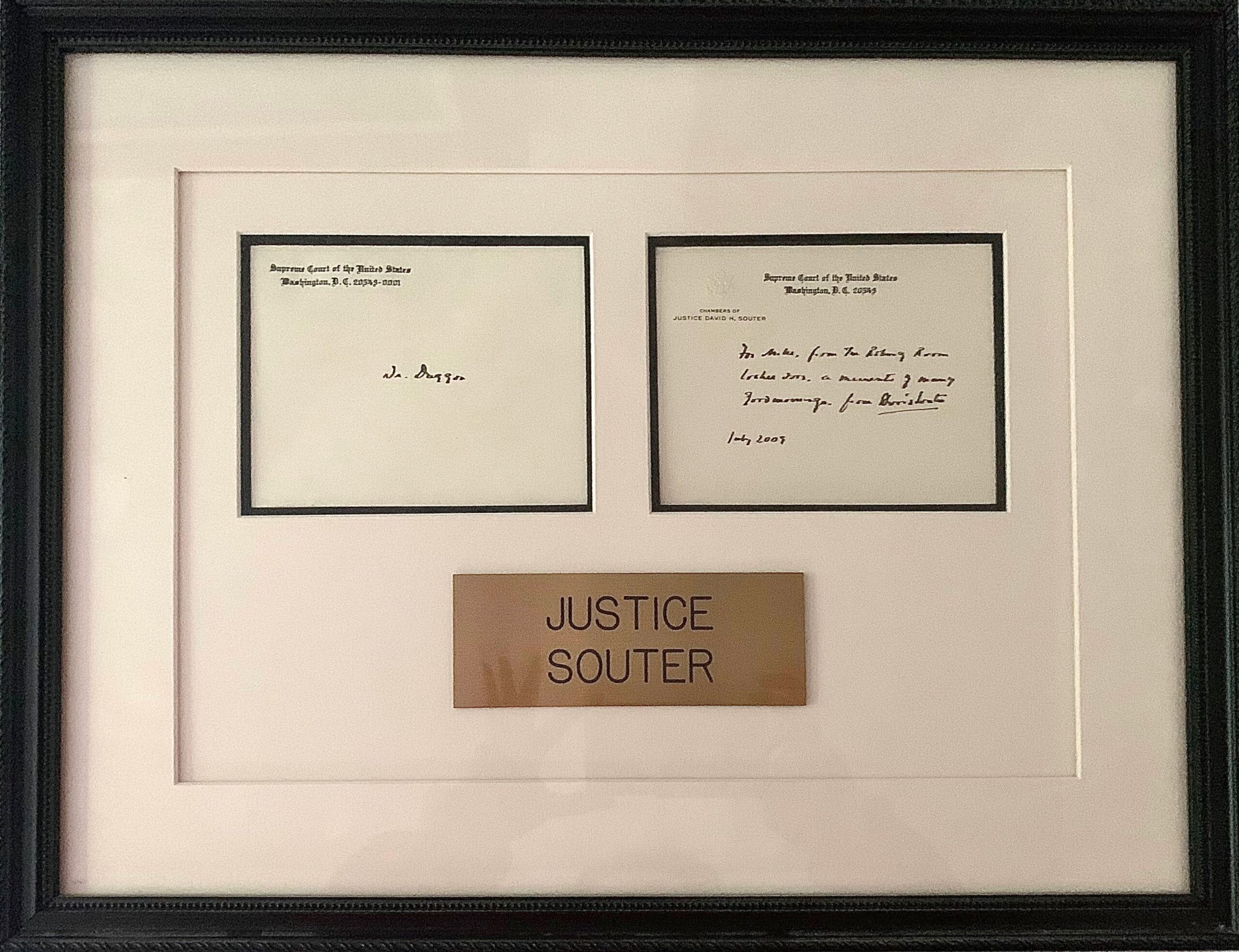
With the note was a 6” by 2.5” brass nameplate reading JUSTICE SOUTER. The small plaque and note it came with are now framed and hang in my hallway. Besides the friendship of my former colleagues and the many good memories, it is the thing from my 30 years at the Court that I treasure most.
Justice David Souter was a great and good man, and he and his legacy stand in marked contrast to so much of what is wrong with the country today. Philosophically and temperamentally, he is close to my ideal of what a justice should be, and I believe that he is among the most underrated American public figures of the past half century. I hope that history will remember him with the likes of Justices Brennan, Harlan II, and Holmes. As a student and professor of history, I know I will. We were lucky to have him. If you think of it, raise a glass of port to his memory sometime.